
Why "waterproof" is a question worth asking early
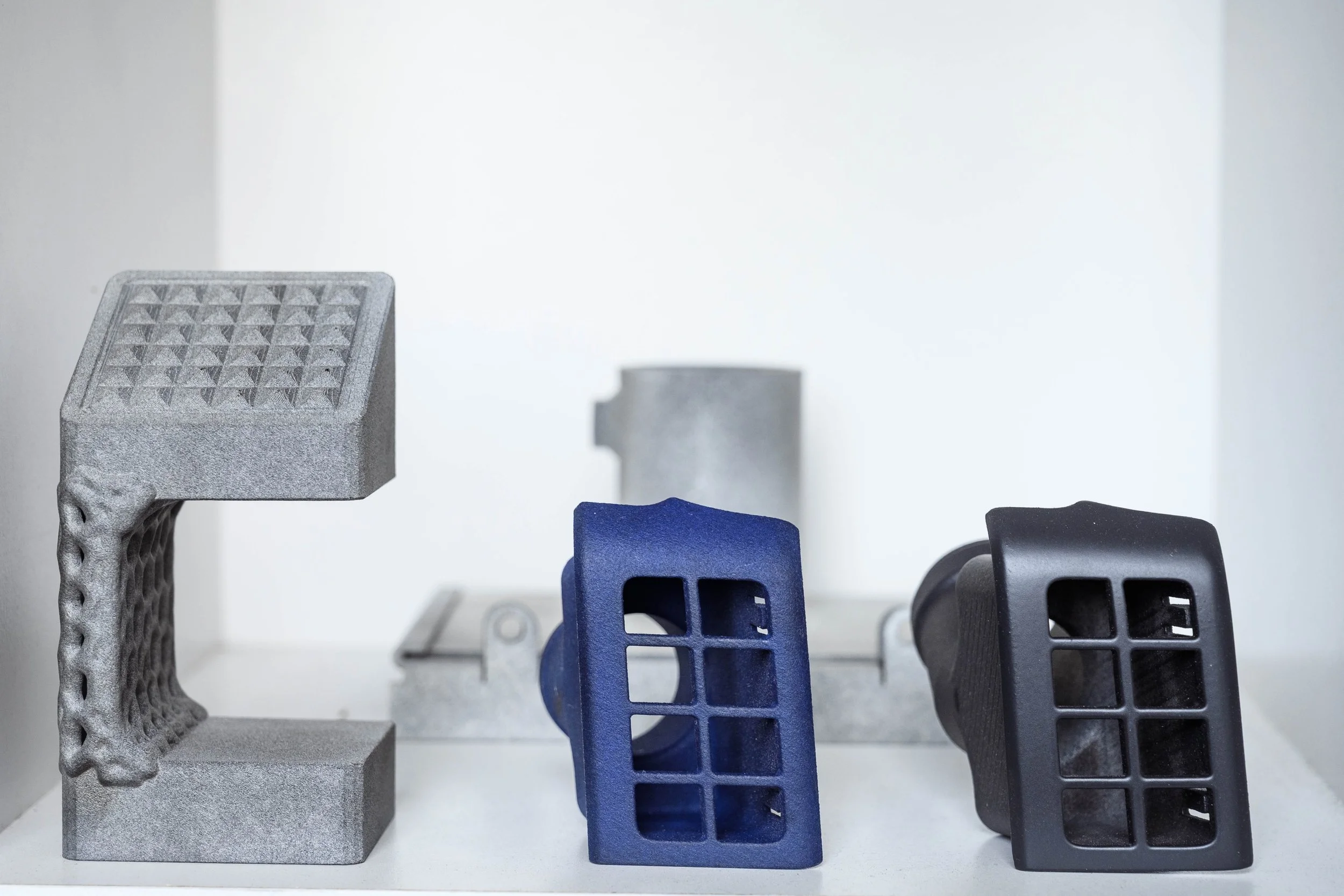
If your product is going to live near water, the time to think about water resistance is at the design stage, not after the first batch comes back. We work with a lot of manufacturers in marine, agritech and outdoor applications, and the same question comes up again and again: will these parts hold up when they get wet, splashed, submerged or exposed to the weather?
The honest answer is that it depends on the material, the geometry and the finish. Additive manufacturing gives you real control over all three, which is exactly why it suits water-facing products so well. Let's walk through what actually matters.
What the material does on its own
Most of our additive manufacturing work uses engineering-grade polymers such as PA12 nylon. On its own, this material is chemically stable, doesn't absorb much moisture, and stands up well to repeated water contact. For many applications, that baseline water resistance is enough. Think brackets, housings, clips and components that get rained on, hosed down or splashed in normal use.
Where you need to be precise is the difference between water-resistant and fully watertight. A standard printed part has a slightly porous surface. For a sealed enclosure, a part that sits underwater for long periods, or anything holding pressure, that porosity needs to be addressed rather than assumed away. Telling us the real operating conditions up front lets us specify correctly the first time.
How finishing closes the gap
This is where our process earns its keep. Surface finishing, such as our polymer blasting service, smooths the part and reduces the open texture that lets water sit. For applications that need to be genuinely watertight, we can advise on sealing approaches and design features, like wall thickness, gasket channels and overlap joints, that make a part reliably water-ready.
Good waterproofing is rarely one thing. It's the right polymer, a geometry designed for the job, and a finish chosen for the environment the part will live in. Getting those three working together is the job, and it's the kind of problem our product development team enjoys solving alongside your engineers.
Why low volume is the smart way to prove it
The real advantage of additive manufacturing here is that you can test before you commit. Rather than tooling up for a full production run and hoping the seal holds, you can produce a low volume batch, put it in the water, and see how it performs in the field. If something needs adjusting, we change the design and reprint, without the cost and delay of new tooling.
That's the bridge we exist to provide: from a working prototype, through low-volume runs of up to 30,000 units, to a proven product you can confidently scale. For exporters refining a product for a niche international market, that ability to iterate quickly and cheaply is often the difference between getting to market and getting stuck.
Let's get your part water-ready
If you're developing a product that needs to stand up to water, talk to us early. The sooner we understand the conditions it has to survive, the better we can specify the material, design and finish to match.
Contact us to discuss your manufacturing challenge or product development project, and let's see if we can help you get to market more efficiently and cost effectively.
