
Why some parts can only be made with additive manufacturing
Every product designer eventually runs into the same wall: an ideal part geometry that no traditional manufacturing process can actually produce. It's usually somewhere the tool simply can't reach.
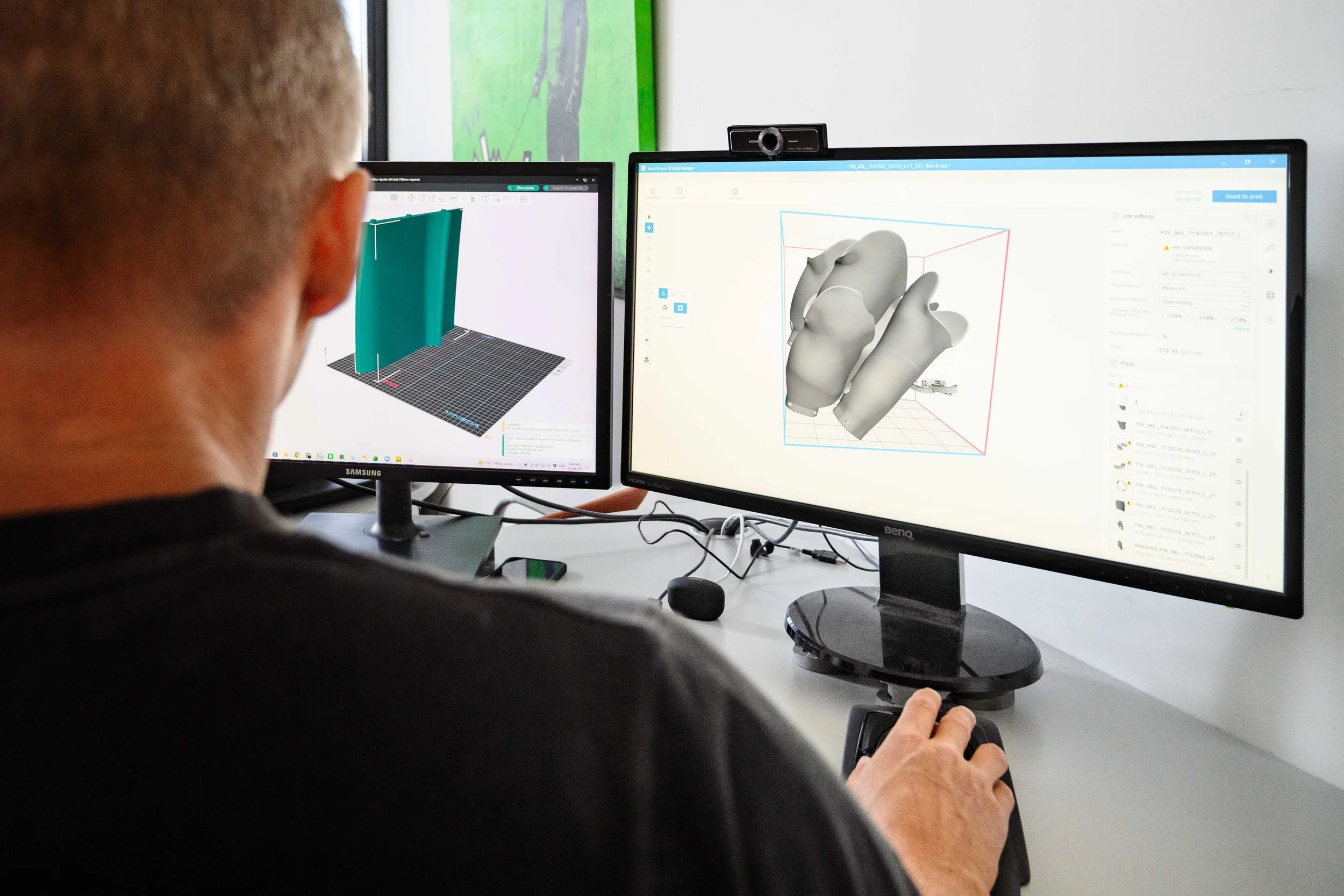
We ran into exactly this recently, working on an automated part with a housing that includes an internal vent. The vent needed a specific tail-end shape to direct airflow correctly, sitting inside a tight space where it couldn't collide with the surrounding components. On paper, it was the right design. In injection moulding, it would have been impossible to produce.
Why the geometry breaks traditional manufacturing
Injection moulding relies on being able to release a mould tool from the finished part. Anything with internal ducts, undercuts, or enclosed cavities creates a problem: there's no way to pull the tool back out without damaging the part, or the geometry itself. That usually forces a redesign, a multi-part assembly, or a compromise on performance.
Additive manufacturing removes that constraint entirely. Because we build the part layer by layer rather than moulding it, there's no tool to release. Geometry that would be a dealbreaker for moulding is simply built as designed, in one process, with no assembly required afterwards.
Getting the fit right without adding cost
Getting a part like this right rarely happens in one pass. We went through multiple design iterations to land on the correct angles and fit for the space it needed to sit in, refining the geometry each time to make sure it cleared surrounding parts with no collisions. This is where working from a parametrically designed CAD model pays off.
Once the model is built this way, adjusting the design between iterations is a matter of manipulating a few variables, not starting again. We reprint, check the fit, and refine, without adding cost each time we make a change. For a business developing a new product, that means the iteration process that usually eats budget and timeline becomes a normal, low-risk part of getting to the right answer.
Built for real use, not just prototyping
The material matters here too. We manufacture these parts using HP Multi Jet Fusion, which allows us to produce genuinely strong, functional features like living hinges and clips directly in the part. These hold up over time and repeated use, unlike similar features produced with other additive technologies such as FDM, which tend to degrade or fail with use. That's the difference between a proof-of-concept and an end-use part. These components come straight out of the machine ready to perform in the field, not just to look right on a bench.
Where this fits into your product development
If your product has a feature that's proving impossible to manufacture the conventional way, that's often a sign it's a strong candidate for additive manufacturing rather than a reason to redesign it out.
Get in touch to discuss your manufacturing challenge or product development project, and let's see if we can help you get to market more efficiently and cost effectively.
