PA12 nylon: rigid or flexible, it comes down to the design
One material. Two completely different jobs. That's the question we get asked most often when it comes to polymer parts: can the same material be tough enough to hold its shape under load, and flexible enough to bend without cracking? With PA12 nylon, the answer is yes, and the reason comes down to design, not the material itself.
Why PA12 nylon covers so much ground
PA12 is one of the most widely used materials in additive manufacturing, and for good reason. Produced through HP's Multi Jet Fusion process, it's an engineering-grade polymer that holds tight tolerances and produces consistent, durable parts straight off the build. Its broad property range is what makes it useful across so many applications, from structural components through to moving, functional parts, without switching to a different material for each job. That flexibility (in the material sense, not just the mechanical one) is a big part of why PA12 has become a go-to choice for product developers working across such different sectors.
Built for rigidity and durability
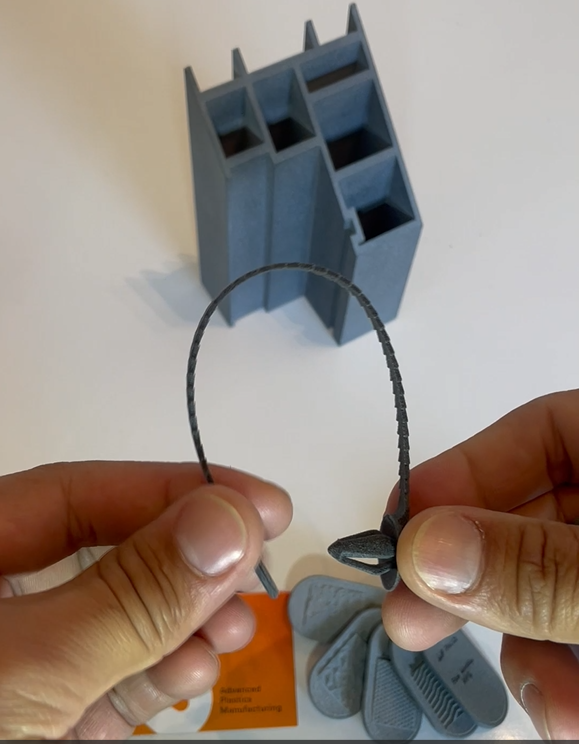
Some parts need to hold their shape, plain and simple. A window profile section is a good example: it needs to be hard-wearing and dimensionally stable enough to stand up to functional testing, without warping, flexing, or losing accuracy under load. For parts like this, we design in thicker wall sections and geometry that resist flex, giving you a rigid, durable component that performs the way a structural part should, whether it's a prototype heading into testing or a low volume production part heading out to a customer.
Designing in flexibility, without changing the material
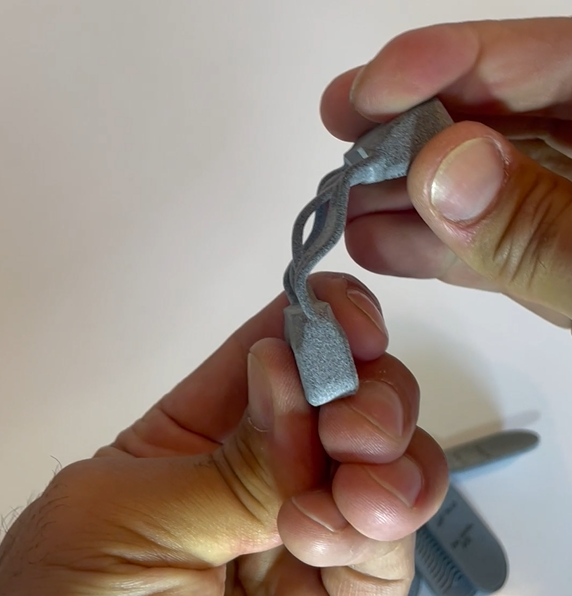
At the other end of the scale, some parts need to move. Zip ties and clip mechanisms are a good example: they need enough flex to snap into place and hold, without fatiguing or cracking over repeated use. We achieve this with PA12 by reducing wall thickness, often down to around 1.5 to 2mm, and adjusting the part's geometry accordingly. Thin enough to flex, but thick enough to keep doing its job cycle after cycle, that's the balance we're designing for. It's a good example of how much can be achieved through design alone, well before you'd need to reach for a different polymer.
The material doesn't change. What changes is how we design around it.
Why this matters for your project
This is the value of working with an experienced additive manufacturing partner: knowing how to tune a single material to sit exactly where your application needs it, rigid, flexible, or somewhere in between, and getting it right the first time. We've applied this thinking across parts for drone aeronautics, agribusiness, marine, motorsport, trucking and general engineering projects, where durability and weight both matter. A lighter, well-designed PA12 part can make a real difference for export businesses shipping product overseas or building equipment that needs to perform out in the field.
Whether you need a single prototype to test a new design or a low volume manufacturing run to fulfil an order, PA12 nylon gives you a lot of room to work with, and durable, lightweight results wherever your part sits on that spectrum.
Have a part in mind that needs to be rigid, flexible, or both? Contact us to discuss your manufacturing challenge or product development project, and let's see if we can help you get to market more efficiently and cost effectively.